

Crewe’s Bespoke Division Defines Open-Top Luxury
Some cars arrive at a motor show and blend into the crowd. Others demand that you stop, lean in, and count the stitches. The Continental GT Mulliner Convertible falls firmly into the second category. Unveiled by Bentley on 19 February ahead of its formal public debut at the Geneva International Motor Show on 3 March, this open-top grand tourer sits at the very apex of the Continental GT family — a car hand-finished by the oldest automotive coachbuilder still in operation.
Mulliner is not merely a trim package bolted onto an existing model line. It is Bentley’s in-house bespoke commissioning division, staffed by artisans at Crewe who take a standard Continental GT Convertible and rework it from the grille to the tonneau cover. For this latest creation, the brief was straightforward in theory and staggering in execution: push the craftsmanship benchmark higher than anything the Continental GT range had previously offered, roof open or closed.
A Grille That Sets the Tone
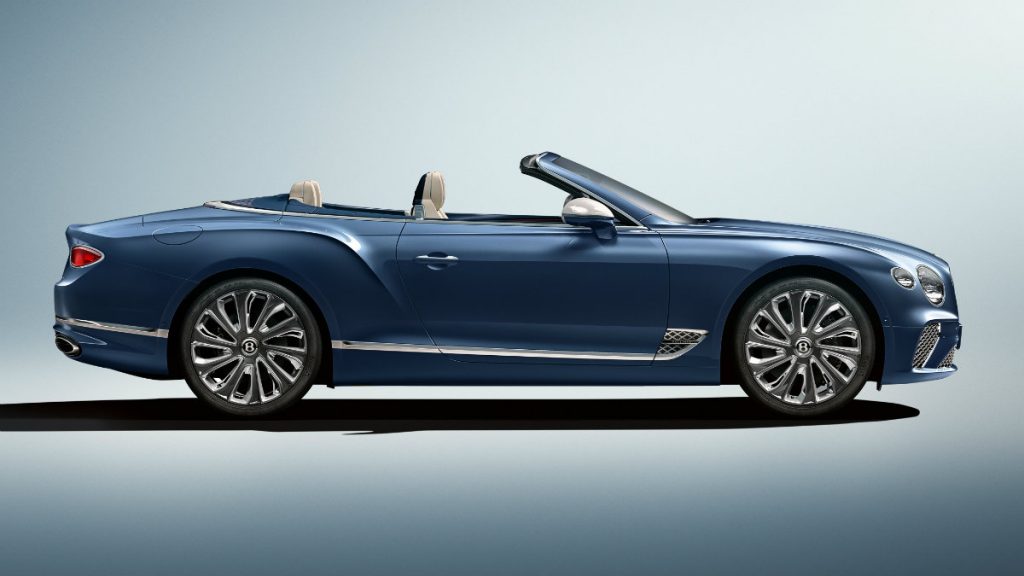
Take a walk around the nose. Sitting between the cut-crystal-effect headlamps — themselves precision-machined with faceted internal lenses that refract light like jewellery — Mulliner has installed a Double Diamond front grille. The mesh pattern repeats a diamond-within-a-diamond motif rendered in bright chrome and dark tinted finish, a theme that then carries rearward into bespoke Mulliner-branded side vents. The silver-on-black diamond motif does not shout. It catches the eye at a distance, then rewards a closer look.

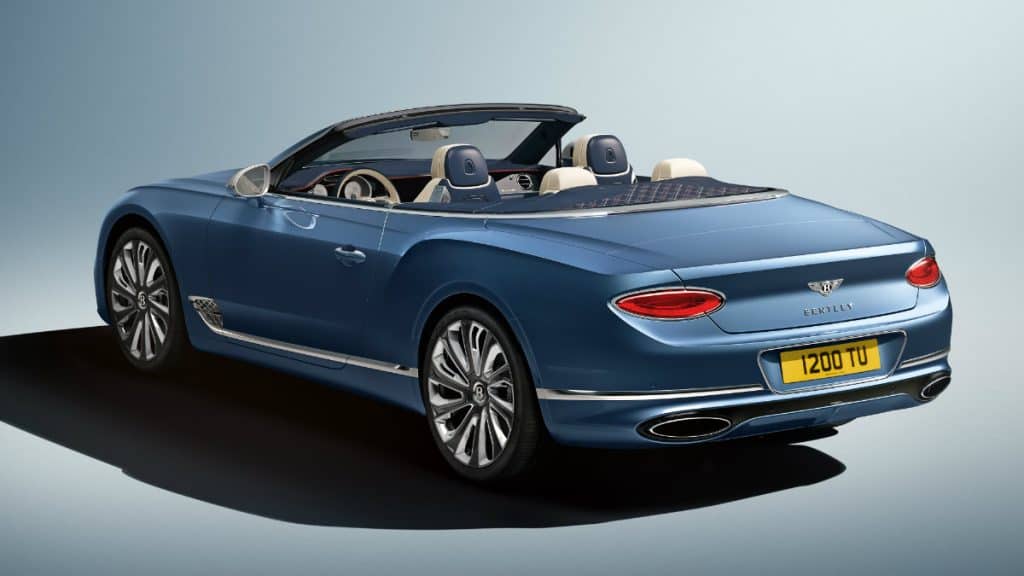
Profile-wise, the car rides on new 22-inch 10-spoke wheels, painted and polished, with floating self-levelling centre badges that hold the Bentley ‘B’ upright regardless of road speed. It is a small detail — the sort a passer-by might never notice — but it speaks to the mindset that Mulliner brings to every surface.
Four Hundred Thousand Stitches
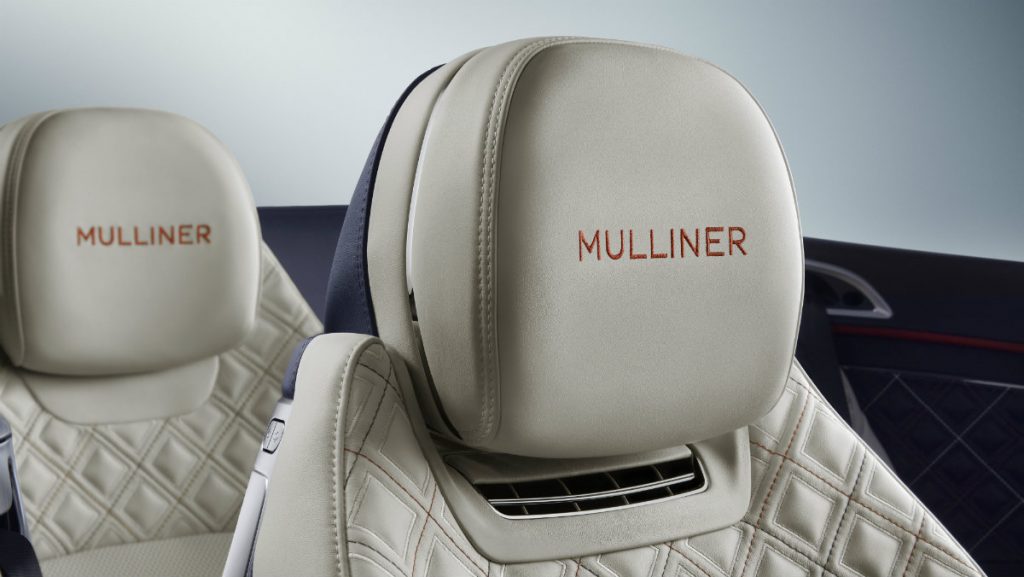
Open the door and the first thing that arrests attention is not the leather itself but the geometry of the stitching. Mulliner’s Diamond-in-Diamond quilting — previously confined to seat bolsters and door panels on the coupe — now extends across all four seats, the door casings, the rear quarter panels, and for the first time, the tonneau cover that conceals the folded roof. Each diamond shape contains exactly 712 individual stitches, every one aligned to point toward the centre of the diamond it forms. The quilting runs in two complementary contrast thread colours, chosen to accentuate depth and pattern rather than simply pop against the hide.
Doing the maths: roughly 400,000 stitches cover the cabin. Developing the embroidery programme that could execute this pattern with the required precision consumed eighteen months before the first production-trim seat left the Crewe workshop. That is the kind of lead time that mainstream suppliers would find hard to justify. Mulliner operates on a different clock.
Eight three-colour combinations have been developed exclusively for this model. A Mulliner-designed colour split introduces a third accent shade applied as a distinctive design line running through the interior, and the hand-stitched hides carry Mulliner-branded embroidery as standard. Customers can of course go further — Mulliner’s commissioning process is built around saying yes to unusual requests, whether that involves matching a favourite scarf or a particular shade of Connemara granite.
Breitling, Bullseyes and Brushed Silver
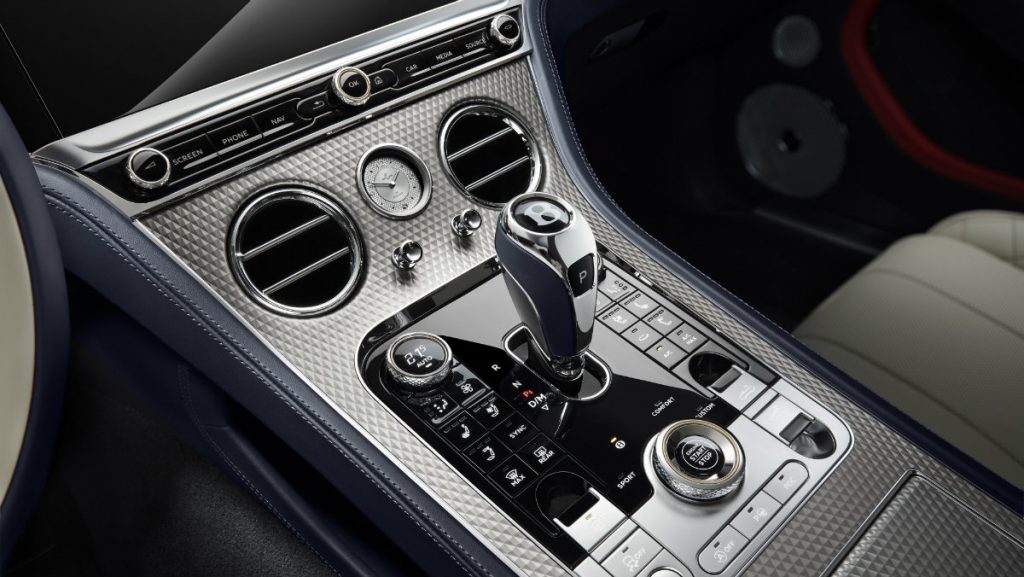
The centre console wears a contrast diamond-milled technical finish — aluminium that has been machined to expose raw facets alongside polished ridges, giving it a tactile, almost architectural quality. Set within a quartet of chrome bullseye vents sits a new brushed-silver Breitling clock, exclusive to the Mulliner Convertible. It is interior jewellery in the truest sense, the sort of piece you glance at during a quiet moment on a motorway rather than actually need to read.

The same brushed-finish theme migrates into the digital realm. The LED driver’s instrument panel — Bentley’s configurable 12.3-inch display — carries Mulliner-specific gauge graphics and branding, so the physical and virtual cabin speak the same visual language. Mood lighting with seven selectable themes, illuminated Mulliner tread plates, and LED welcome lamps that project Bentley’s winged ‘B’ logo onto the tarmac from the door mirrors round out the ambience package.
Sound and Ceremony
Roof down, audio quality becomes paramount — wind noise competes with every frequency band, and a mediocre system dissolves into background mush. Mulliner specifies the top-tier Naim for Bentley setup: eighteen speakers plus two Active Bass transducers, driven by a 2,200-watt, 20-channel amplifier with eight DSP sound modes. It is overkill in the best sense, delivering presence and body even at motorway speeds with the fabric roof stowed beneath the tonneau.

Ownership rituals matter at this price point. Customers receive their keys in a handcrafted Mulliner-branded presentation box trimmed in the same three-colour leather combination specified for the car’s interior. Two keys arrive in individually colour-matched cases with contrast stitching. It is an unboxing experience that begins long before you touch the door handle.
Twin-Turbo W12 or V8 — Take Your Pick
Beneath the bonnet, the Mulliner Convertible is available with either of the two powertrains that underpin the wider Continental GT range. The headline act remains Bentley’s 6.0-litre, twin-turbocharged W12. In this application it delivers 0–60 mph in 3.7 seconds (0–100 km/h in 3.8 seconds) and a top speed of 207 mph (333 km/h). The twelve-cylinder layout gives it a torque characteristic that feels bottomless rather than explosive — effortless surge rather than kick-in-the-back drama.
The newer 4.0-litre, twin-turbocharged V8 is hardly a consolation prize. It reaches 198 mph (318 km/h) and covers 0–60 mph in 4.0 seconds (0–100 km/h in 4.1 seconds), while trimming weight over the front axle and sharpening turn-in response. For drivers who plan to exploit the Mulliner Convertible on a twisting alpine pass rather than an autobahn, the V8 may be the more engaging choice.
Sixty-One Colours — or One of Your Own
The exterior paint palette extends to 61 colours within the Mulliner range, spanning Bentley classics and more adventurous hues. If none of those satisfy, customers can commission Bentley’s artisan paint specialists to colour-match against any physical sample — a fabric swatch, a favourite watch dial, a childhood toy. Mulliner’s personal commissioning team at Crewe handles the matching and approval process, and the resulting finish carries the same durability warranty as a standard colour.
The Oldest Coachbuilder in the Room
Mulliner traces its lineage back to the sixteenth century, when the family firm built custom carriages for British aristocracy. It bodied Bentleys from the earliest days of the marque and became Bentley’s official bespoke division long before the word “personalisation” entered automotive marketing. Today, the Crewe-based team operates with in-house engineers, designers and trim specialists who can respond to requests that range from subtle — a unique wood inlay, perhaps — to ambitious one-off bodywork.
The Continental GT Mulliner Convertible represents the accessible end of that capability: a production model with a fixed menu of Mulliner enhancements, available to order through the dealer network rather than commissioned one at a time. For buyers who want the Mulliner finish without the eighteen-month wait of a full bespoke programme, it is the clear flagship of the open-top Continental GT lineup.
Bentley confirmed at Geneva that the Mulliner Convertible will become available in EU28 countries, Israel, Norway, Switzerland, Turkey and Ukraine later in the year, following its initial market rollout. Pricing follows the Mulliner tradition: quoted on application, because at this level of specification, almost every example leaves Crewe with a different final figure.


Vehicle data
| Make | Bentley |
| Model | Continental GT Mulliner Convertible |
| Generation / chassis code | Third-generation Continental GT (GTC) |
| Body style | 2-door convertible (soft-top) |
| Powertrain / engine (W12) | 6.0-litre twin-turbocharged W12 |
| Powertrain / engine (V8) | 4.0-litre twin-turbocharged V8 |
| Key performance figures (W12) | 0–60 mph in 3.7 s (0–100 km/h in 3.8 s); top speed 207 mph (333 km/h) |
| Key performance figures (V8) | 0–60 mph in 4.0 s (0–100 km/h in 4.1 s); top speed 198 mph (318 km/h) |
| Drivetrain | All-wheel drive |
| Transmission | 8-speed dual-clutch automatic |
| On-sale / announcement period | Announced 19 February; global debut at Geneva International Motor Show, 3 March; further markets later in the year |
| Market | Global (initial markets first; EU28 and others to follow) |