
A New Benchmark for Grand Touring: The Third-Generation Bentley Continental GT
When Bentley took the wraps off the third-generation Bentley Continental GT ahead of its Frankfurt Motor Show public unveiling in September 2017, the British marque did far more than revise a successful silhouette. It re-engineered its flagship coupe from the pavement up. Designed, engineered, and handcrafted at Bentley’s headquarters in Crewe, England, this new grand tourer arrives carrying the weight of a franchise: since the original Continental GT broke cover in 2003, more than 66,000 examples have rolled out of the factory gates, establishing Crewe as the undisputed epicenter of twelve-cylinder luxury coupes. The third-generation car is tasked with defending that ground against formidable modern competition, armed with an all-new platform, advanced chassis electronics, and an extensively reworked W12 powertrain.
Wolfgang Dürheimer, chairman and chief executive of Bentley Motors, framed the arrival as a milestone moment during the car’s initial reveal: “Bentley has been at the forefront of luxury Grand Touring for nearly one hundred years. The new, third-generation Continental GT is the pinnacle of our design and engineering achievements and marks the next step in Bentley’s journey. We are the world leader in luxury mobility and our products and services define new luxury in the automotive world. The new Continental GT encapsulates our desire to innovate as well as celebrate our heritage and take the Bentley ownership experience to the next, unparalleled level.”

Design and Proportions: Super Formed Aluminium and EXP 10 Speed 6 DNA
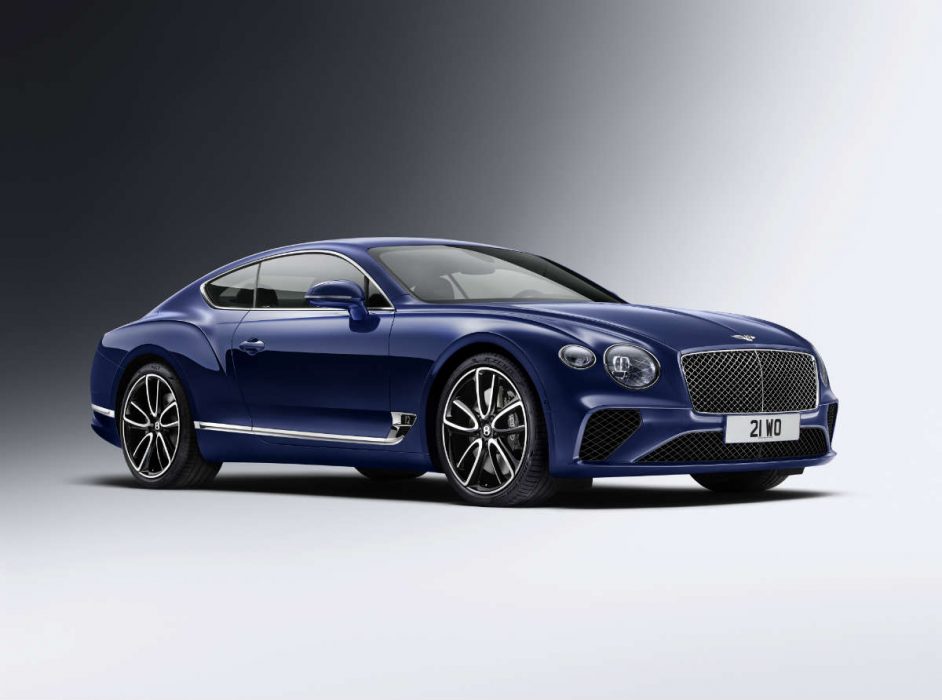
Visually, the third-generation Continental GT draws direct inspiration from Bentley’s critically acclaimed EXP 10 Speed 6 concept car, translating concept-car theatre into a series-production coupe. The new body shell sheds more than 80 kg compared to the previous Continental W12 body, yet boasts significantly higher torsional stiffness. To achieve these sculpted body lines, Bentley deployed Super Formed technology across the aluminum skin. In this precision aerospace process, aluminum sheets are heated to 500°C and shaped using air pressure, enabling designers to execute razor-sharp creases and dramatic surface changes that conventional stamping presses cannot stamp without tearing.
Crucially, the Continental GT is the first series production car in automotive history to feature an entire bodyside crafted as a single Super Formed panel. The visual transformation is immediately apparent in the stance: the front wheels have been shifted forward by 135 mm, a change that shortens the front overhang, elongates the bonnet, and allows the nose to sit substantially lower to the asphalt. Bentley’s trademark ‘power line’ still emerges from the headlamps and sweeps rearward, but now feeds into a deeper, muscular rear haunch that conveys genuine athleticism rather than sheer mass. Around back, the styling breaks decisively from earlier Continental generations: elliptical taillights echo the silhouette of the dual exhaust outlets below, creating a cohesive visual signature in the dark.

Detailing throughout the exterior reveals an obsession with optics and precision metalwork. The lighting assemblies incorporate the latest full LED Matrix technology, but their internal design is inspired by cut-crystal glassware. The transparent inner surfaces feature crisp, sharp facets that refract light like gemstones, producing an illuminated sparkle that is further dramatised when the welcome lighting sequence awakens the car as the owner approaches. At the rear, the exhaust tailpipes feature an intricate perforated inner sleeve that provides visual depth while actively cooling the exhaust gas envelope. Staggered 21-inch wheels come fitted as standard equipment in two distinct finishes, while an optional 22-inch lightweight forged wheel offers a hand-twisted polished face for buyers demanding maximum presence.

Inside the Cabin: Craftsmanship, Kotas, and the Bentley Rotating Display
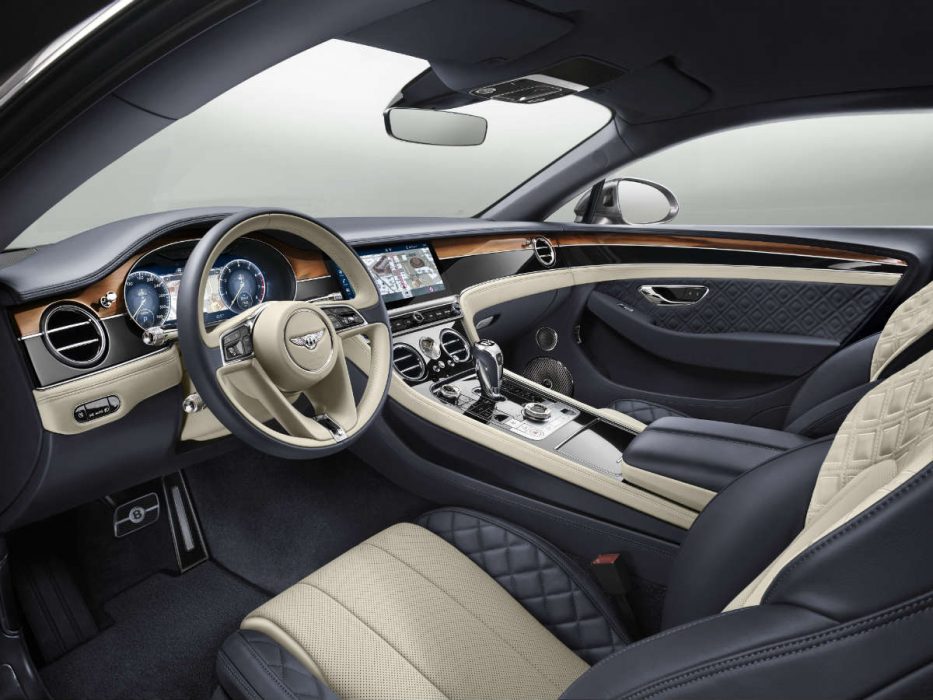
Inside, the Continental GT represents a masterclass in modern coachbuilding. Crewe’s artisans use more than ten square meters of sustainably sourced wood veneer in each car, with manual layout and hand-fitting requiring nine hours per vehicle. The fascia can now be specified with book-matched dual veneers, pairing open-grain or mirror-matched timbers such as newly introduced Koa wood with dark high-gloss lacquers. Across the dashboard, sweeping horizontal wings echo the Bentley flying ‘B’ logo, terminating gracefully into door panels trimmed with smooth, natural leathers drawn from a standard palette of 15 hide hues and matching carpeting.
The centerpiece of the cockpit technology is the Bentley Rotating Display, a three-sided rotating instrument module positioned in the dashboard fascia. When the car is locked, the dashboard appears as an uninterrupted ribbon of wood veneer framed by a subtle chrome bezel. Press the engine start button, and a central veneer section pivots smoothly forward to reveal a 12.3-inch Retina-grade digital MMI touchscreen. Configurable with three customizable tiles, the system supports smartphone integration via Apple CarPlay, Google POI search, and live traffic telemetry. For drivers desiring an analog reprieve, a third rotation presents three jewel-like analog dials: an outside temperature gauge, a compass, and a chronometer. The digital instrument binnacle in front of the driver mirrors this versatility, rendering photorealistic 3D virtual gauges and navigation mapping with high graphical fidelity.

The physical touchpoints throughout the cockpit showcase exceptional tactile finishing. The center console can be specified in Côtes de Genève, a technical surface inspired by Swiss haute horlogerie where 0.6 mm-thick aluminum is machined in 5 mm bands at precise microscopic angles to produce a shimmering three-dimensional wave pattern. Switchgear on the iconic organ-stop ‘Bullseye’ air vents, climate rotary bezels, and drive mode controllers feature diamond and pillow knurling, complemented by bronze inserts sandwiched within key controls to enhance tactile feedback. The front seats provide 20-way power adjustment with active ventilation, heating, and multiple massage programs. When optioned with the new ‘diamond-in-diamond’ quilting, each leather diamond incorporates 712 individual embroidered stitches, a stitch architecture that required 18 months of software optimization and bespoke machine programming to execute perfectly without stretching the leather grain.

Acoustic isolation has been upgraded through the standard fitment of laminated acoustic glass for the windscreen and side windows, delivering a nine-decibel reduction in cabin noise compared to the outgoing second-generation model. This quiet interior provides the foundation for three bespoke audio systems: a standard 650-watt, 10-speaker setup; an intermediate 1,500-watt, 16-speaker Bang & Olufsen array featuring illuminated speaker grilles and BeoSonic one-touch acoustic profiling; and a range-topping 2,200-watt, 18-speaker Naim audiophile system fitted with Active Bass Transducers integrated directly into the front seat frames.
The W12 TSI Engine and Dual-Clutch Transmission
Under the extended aluminum hood sits an enhanced 6.0-liter twin-turbocharged W12 TSI engine, hand-assembled in Crewe. Thanks to its unique W-configuration, the twelve-cylinder block is 24 percent shorter than a conventional V12, allowing engineers to tuck the mass further back in the chassis to optimize weight balance. Powered by dual high-pressure direct and low-pressure port injection systems, the revised powerplant generates an immense 635 PS (626 bhp / 467 kW) and 900 Nm (664 lb-ft) of torque. Engine management computers execute 300 million software calculations per second to govern boost, valve timing, and cylinder deactivation. Under light cruise conditions, Bentley’s Variable Displacement system imperceptibly shuts down six cylinders—deactivating intake and exhaust valves, fuel delivery, and ignition—turning the W12 into an efficient six-cylinder engine to preserve highway range.
The transmission marks a fundamental departure from the previous generation: a dual-clutch eight-speed gearbox replaces the traditional torque-converter automatic. A dual-mass flywheel dampens driveline vibrations, ensuring smooth urban creeping while enabling lightning-quick shifts under throttle. Shift mapping alters dynamically with drive mode selection: Comfort mode delivers imperceptible transitions, while Sport mode executes rapid-fire cog swaps designed to maintain boost and continuous torque delivery. Top speed of 333 km/h (207 mph) is reached in seventh gear, while eighth functions as an overdrive ratio for quiet, low-rpm high-speed cruising. A dedicated Sport Launch function pre-loads clutch pressure, launching the heavy grand tourer from 0 to 100 km/h in just 3.7 seconds (0-60 mph in 3.6 seconds).
Chassis Engineering: 48V Active Roll Control and Adaptive All-Wheel Drive
The third-generation Continental GT drops the permanent 40:60 front-to-rear torque split of its predecessor in favor of a rear-biased active all-wheel-drive system. Under ordinary driving conditions, the car operates predominantly as a rear-wheel-drive machine, sharpening turn-in bite and enhancing steering feedback. When wheel slip or aggressive lateral loading is detected, an electronically controlled multi-plate clutch instantly directs torque to the front axle, banishing understeer without corrupting the rear-wheel balance enthusiasts expect from an athletic grand tourer.

Body motions are commanded by Bentley Dynamic Ride, an advanced 48-volt active roll control system. High-output electric actuators mounted inside each anti-roll bar apply instantaneous counter-torque across the front and rear suspension linkages during cornering. This decouples ride comfort from lateral stiffness: in a straight line, the bars decouple to let individual wheels absorb road imperfections without tossing the cabin, while cornering loads trigger instant bar stiffening that holds the Continental flat through fast sweepers. Driver modes selected via Bentley’s Drive Dynamics Control (Comfort, Bentley, Sport, or Custom) recalibrate the roll actuators alongside the new three-chamber air suspension, which contains 60 percent more air volume in its plush setting than the outgoing car’s air springs.
Continuous Damping Control (CDC) monitors wheel and body acceleration constantly, fine-tuning damping forces at each corner in milliseconds. Directional agility is assisted by an Electric Power-Assisted Steering (EPAS) setup with a variable ratio rack that is quick off-center for maneuvering yet stable and reassuring at highway velocities. The braking package is suitably massive: the front cast-iron ventilated discs grow by 15 mm to 420 mm in diameter, clamped by multi-piston calipers, ensuring repetitive high-speed deceleration from autobahn speeds without thermal fade.
Packs, Mulliner Personalization, and Rigorous Validation
To assist buyers navigating Bentley’s bespoke catalog, the Continental GT debuts with curated option packages. The City Specification bundles urban-focused technology, including a 360-degree top-view camera system, hands-free boot opening, pedestrian detection, traffic sign recognition, and automatic low-speed city emergency braking. The Touring Specification focuses on effortless cross-continental journeys, incorporating adaptive cruise control with traffic jam assist, active lane-keeping assistance, a heads-up display, night vision with thermal infrared scanning, and pre-sense collision mitigation.
For a sharper sporting emphasis, the Mulliner Driving Specification adds 22-inch lightweight forged alloy wheels, diamond-in-diamond quilted seats and door casings, embroidered Bentley emblems on the headrests, drilled aluminum sports pedals, a jeweled-finish alloy fuel filler cap, and an indented leather headliner. Beyond factory bundles, Bentley’s bespoke Mulliner commissioning division offers custom exterior paint matches beyond the 17 standard and 70 extended paint colors, bespoke contrast stitching, personalized treadplate engraving, and tailored luggage sets crafted to fill the enlarged boot aperture.
Before entering series production, Bentley test teams subjected third-generation Continental prototypes to roughly one million kilometers of torture testing across extreme environments. Durability test mules navigated sub-zero testing on frozen lakes in Sweden, durability test loops across South African gravel and washboard tracks, high-heat powertrain trials in the Middle East, and high-ambient thermal soak trials in Death Valley, California, where temperatures approached 50°C below sea level.
Manufacturing in Crewe also reflects upgraded environmental standards. Up to 40 percent of the Crewe factory’s electrical demand is generated on-site by 20,815 rooftop solar panels spanning 34,500 square meters—at its installation, the largest industrial solar roof in the United Kingdom. With a peak output of 5.1 megawatts, the array eliminates 2,500 tonnes of carbon dioxide annually, helping Bentley earn Carbon Trust certification for carbon, water, and waste stewardship. As the third-generation Bentley Continental GT prepares for its worldwide rollout, it blends hand-finished Crewe luxury with authentic supercar pace, redefining what a modern grand touring flagship can accomplish.
Vehicle data
| Field | Value |
|---|---|
| Make | Bentley |
| Model | Continental GT |
| Generation / chassis code | Third generation |
| Model year(s) covered | 2018 |
| Body style | 2-door grand touring coupe |
| Powertrain / engine | 6.0-litre twin-turbocharged W12 TSI (dual direct/port injection) |
| Power / torque | 635 PS (626 bhp / 467 kW) @ 6,000 rpm / 900 Nm (664 lb-ft) @ 1,350–4,500 rpm |
| Transmission | 8-speed dual-clutch transmission (DCT) |
| Drivetrain | Active All-Wheel Drive with variable torque distribution |
| Key performance figures | 0–100 km/h in 3.7 s (0–60 mph in 3.6 s), top speed 333 km/h (207 mph) |
| Price (as stated) | Not stated in sources |
| On-sale / announcement period | Unveiled September 2017 (2017 Frankfurt Motor Show / IAA) |
| Market | Global |