

Flagship Luxury Meets Quattro Engineering
The arrival of the Audi Q8 marks a pivotal transition in Ingolstadt’s sport utility hierarchy. Blending the imposing stance of an executive sport utility vehicle with the tapered roofline of a four-door grand tourer, the Q8 establishes itself as the expressive design and technological flagship of the entire Audi Q portfolio. Where earlier models prioritized strictly upright profiles and conventional three-row packaging, the Q8 introduces an athletic presence engineered specifically for drivers who demand prestige, technical sophistication, and cross-country capability in an uncompromising two-row layout.
Dimensionally, the SUV coupe cuts a distinct profile. Stretching 4,986 millimeters (16.4 ft) in total length, standing 1,705 millimeters (5.6 ft) tall, and spanning 1,995 millimeters (6.6 ft) in width across its athletic shoulders, the Q8 is notably wider, shorter, and lower than its established Q7 platform sibling. Riding on an expansive wheelbase of nearly 3.00 meters (9.8 ft), its proportions emphasize planted visual stability. By removing the third row entirely, Audi engineers liberated remarkable interior volume, allowing the Q8 to surpass direct luxury coupe-SUV rivals in cabin length, front and rear shoulder clearance, and rear passenger headroom.
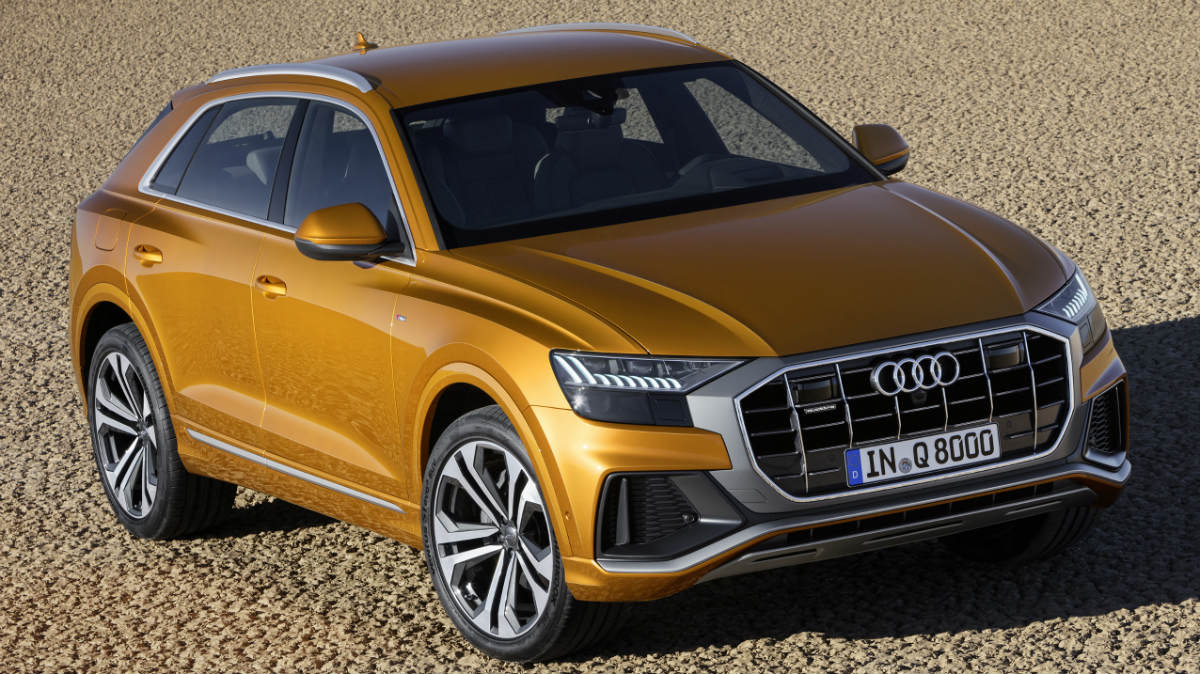
A Sculpted Face: The New Octagonal Singleframe
Visually leading the Q family into a fresh styling era, the Audi Q8 debuts a bold octagonal Singleframe grille that commands immediate attention. The upright radiator mask stands prominent and confident, framed by a forward-drawn front spoiler and deeply sculpted, muscular air inlets. This strong architectural frontal treatment establishes a distinct identity separate from the brand’s saloon range, telegraphing both mechanical potency and luxury stature.
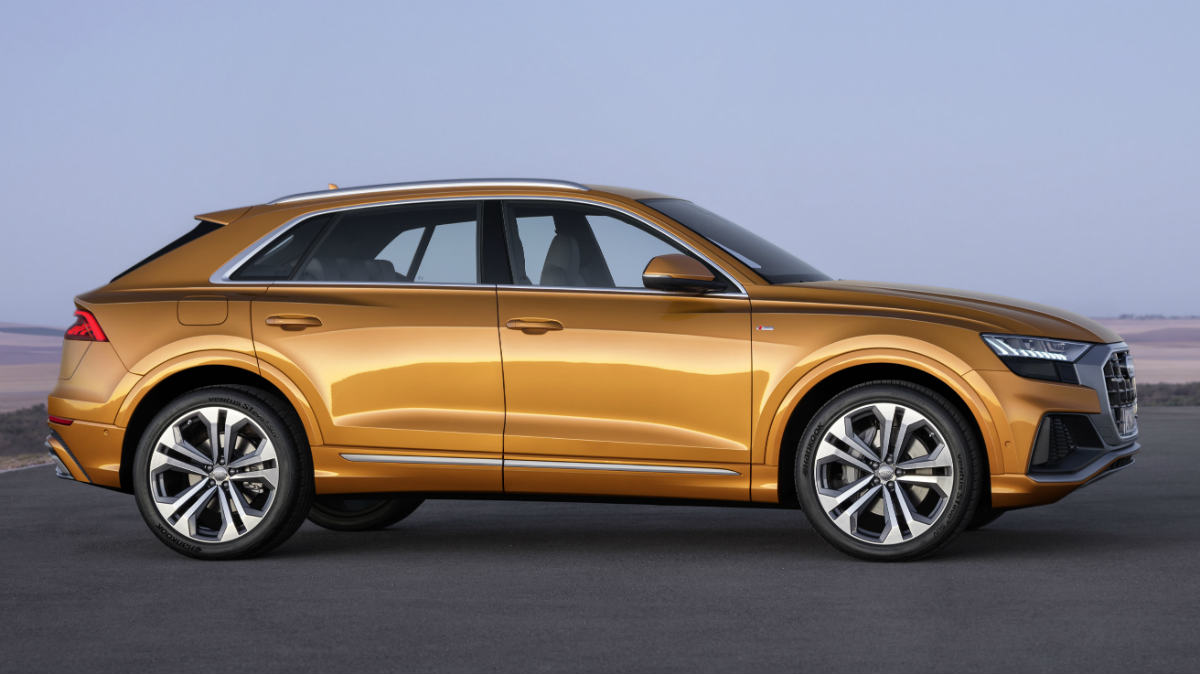
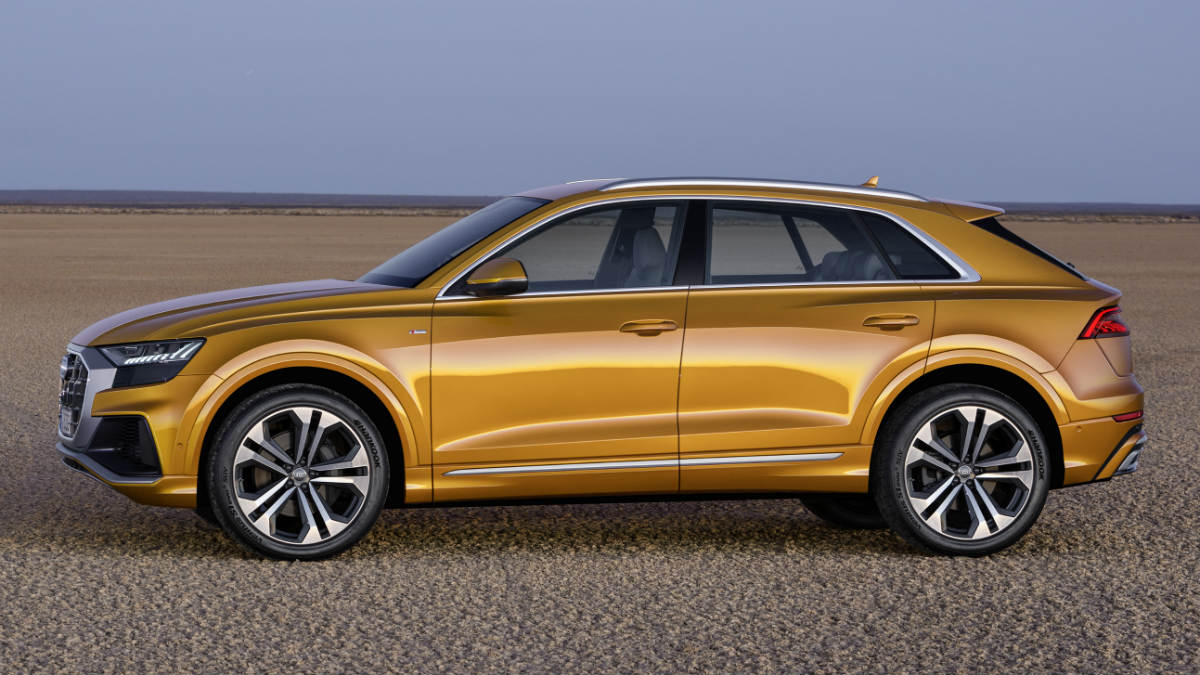
In side profile, the silhouette tapers gracefully toward gently inclined D-pillars that rest squarely over flared wheel arches. These swollen blisters pay deliberate stylistic homage to the rally-conquering Audi Quattro of the 1980s, visually signaling the mechanical grip delivered by permanent all-wheel drive. Accommodating wheels up to 22 inches in diameter, the flared arches anchor a body composed of taut surfaces and athletic character lines. Anthracite and contrasting attachments along the wheel arch trims, lower door mouldings, and rear diffuser complete the purposeful, all-terrain aesthetic.

Lighting Architecture and Digital Signatures
Standard LED headlights illuminate the forward road, with advanced HD Matrix LED technology available as a premium option. In HD Matrix specification, both the daytime running lights and the three-dimensional taillight clusters carry a distinct digital signature, composed of segmented light bars that give the vehicle an unmistakable evening presence. Across the rear tailgate, a full-width continuous light strip connects the rear lighting units, mounted against an underlying black accent strip that again recalls the styling heritage of the original Quattro coupe.
Beyond passive illumination, the lighting setup incorporates active, interactive functionality. Owners can use the myAudi smartphone application to trigger dynamic light staging sequences from outside the vehicle, providing a welcoming visual animation upon approach or departure. The integration of high-resolution Matrix LEDs also ensures intelligent, adaptive road illumination that blocks out oncoming traffic and road signs while maintaining maximum long-range high-beam coverage.
Quattro Permanent All-Wheel Drive and Chassis Dynamics
Audi is synonymous with Quattro, and this mechanical ethos forms the cornerstone of the Q8 chassis engineering. A purely mechanical center differential distributes torque between the front and rear axles in a baseline 40:60 split under ordinary driving conditions. When road surfaces slip or traction thresholds are exceeded, the differential responds instantaneously without electronic latency, diverting up to 70 percent of drive torque forward or directing as much as 85 percent rearward to preserve forward momentum and directional control.
Off-road competence is backed by substantial hardware. With an available ground clearance extending up to 254 millimeters (10.0 inches), paired with short front and rear overhangs and standard hill descent control, the Audi Q8 navigates rough tracks, deep ruts, and steep gradients with genuine authority once paved tarmac ends. The standard suspension incorporates electronically controlled damper regulation, allowing drivers to tailor firmness via Audi drive select modes.
For even broader bandwidth between long-distance wafting and tight-corner composure, buyers can specify adaptive air suspension with controlled damping. Available in either comfort or sport configurations, this pneumatic system continuously adjusts ride height according to driving velocity and selected drive modes, shifting chassis height across a 90-millimeter (3.5-inch) range. At highway cruising speeds, the body automatically drops to reduce aerodynamic drag, while off-road modes raise the chassis to clear trail obstacles.
Agility Through Engineering: Progressive and All-Wheel Steering
Despite spanning nearly five meters from nose to tail, the Audi Q8 handles with agility thanks to progressive steering fitted as standard equipment. Its steering rack ratio becomes steadily more direct as steering lock increases, reducing hand-over-hand input during parking maneuvers while preserving calm, centered stability at sustained motorway speeds.
To further sharpen handling reflexes, an optional all-wheel steering system can be equipped. Controlled via electromechanical spindle drives on the rear axle, the system turns the rear wheels by up to 5 degrees. At slow urban speeds up to approximately 60 km/h (37 mph), the rear wheels turn counter to the front wheels, shrinking the vehicle’s turning circle by roughly a full meter to simplify garage maneuvering and tight turns. At higher velocities, the rear wheels steer in the same direction as the front wheels, enhancing high-speed lane-change stability and reassuring chassis poise through fast sweepers.
48-Volt Mild Hybrid Technology (MHEV)
Efficiency across the Q8 powertrain lineup is fundamentally anchored by a standard 48-volt primary electrical architecture. This mild hybrid system (MHEV) integrates two crucial hardware modules: a compact 10-Ah lithium-ion battery housed beneath the luggage compartment floor and a belt-driven alternator starter (BAS) permanently linked to the engine crankshaft.
During braking and deceleration phases, the BAS functions as a generator, recovering up to 12 kW of kinetic energy and feeding it directly back into the 48-volt battery pack. When cruising between speeds of 55 and 160 km/h (34 to 99 mph), the engine can shut down completely for up to 40 seconds at a stretch, allowing the SUV to coast silently without consuming fuel or producing tailpipe emissions. Once the accelerator is pressed again, the BAS restarts the engine quickly and smoothly. Furthermore, the engine stop-start threshold expands downward to initiate at 22 km/h (13.7 mph), saving valuable fuel in stop-and-go urban traffic.
Interior Architecture: Black-Panel Minimalism and Executive Craftsmanship
Inside the cabin, the Audi Q8 translates modern luxury through clear geometry and digital precision. The dashboard is styled around a sleek black-panel design language where the primary infotainment display blends seamlessly into a glossy black band when powered down. Slim, continuous horizontal lines define the dashboard architecture, originating from an elongated air vent strip and extending across the fascia into door cards lined with premium leathers, woods, and polished aluminum.
The center console features a wide, ergonomic tunnel that houses the yacht-style Tiptronic gear selector lever, shaped deliberately to serve as a supportive wrist rest when interacting with the climate controls. When dusk falls, optional contour and ambient interior lighting highlights the sculptural contours of the center console and doors, casting a delicate backlight through a three-dimensionally laser-etched Quattro emblem set into the trim above the glovebox.
Long-distance travel luxury can be tailored via comprehensive comfort options. Buyers can specify customized contour front seats equipped with pneumatic lumbar adjustments, active three-stage seat ventilation, and multi-program massage functions. A four-zone automatic climate control system allows individual thermal settings for each occupant, complemented by an air quality package featuring an integrated ionizer and subtle cabin fragrancing to maintain an exceptionally fresh interior environment.

Dual-Screen MMI Touch Response and Digital Cockpit
Central to the driver’s environment is Audi’s MMI touch response operating concept, replacing traditional rotary dials and rows of physical switches with two large, high-definition capacitive displays. The upper screen measures 10.1 inches diagonally, serving as the interface for infotainment playback, car setup menus, and real-time navigation mapping. Positioned directly below, an 8.6-inch touchscreen manages four-zone climate adjustments, seat heating and ventilation, and shortcut functions, while also serving as a digital writing pad for handwriting recognition.
Input confirmation is tactile and unambiguous. When an icon or button is pressed on either screen, a pulse from an internal electromagnet provides an audible and mechanical click, reassuring the driver that their selection has been registered without requiring eyes to linger away from the road. Complementing touch interaction, an advanced natural-language voice control system functions as an intuitive dialogue partner. The driver can speak everyday conversational phrases without fixed command structures—stating “I am cold” prompts the climate control system to raise cabin temperature on the driver’s side, while asking for food suggestions brings up nearby dining locations.
Directly in front of the steering wheel sits the Audi virtual cockpit, standard with a pin-sharp 12.3-inch digital instrument cluster. Drivers can toggle between classic dial layouts and full-screen navigation maps via steering-wheel switches. An optional virtual cockpit plus package introduces an additional performance-oriented display mode. Supplementing the instruments, an available full-color head-up display projects critical telemetry, current road speed, speed limit warnings, and junction navigation cues directly into the driver’s primary line of sight on the windscreen.

Connectivity, Swarm Intelligence, and Bang & Olufsen 3D Sound
Fitted as standard equipment on the flagship SUV, the MMI navigation plus system incorporates an integrated Audi connect data communications module running on high-speed LTE Advanced network standards, complete with a built-in Wi-Fi hotspot for passenger devices. The navigation system learns recurring travel patterns over time, using driving history to suggest sensible routing alternatives during heavy traffic periods.
Car-to-X connectivity leverages swarm intelligence gathered across the connected Audi vehicle fleet. Real-time reports broadcast local speed limit changes, road closures, black ice warnings, and sudden fog banks to warn oncoming Q8 drivers before hazards appear in headlights. Individual personalization extends up to 400 vehicle parameters stored across seven driver profiles, adjusting seat positions, radio presets, mirror alignments, and air conditioning settings automatically upon entry.
The optional Audi connect key provides seamless convenience for Android smartphone users, allowing the phone to unlock the doors and start the ignition via Near Field Communication (NFC). The myAudi app also enables remote destination dispatch, synchronization of personal smartphone calendars, and trip data monitoring. Acoustic fidelity inside the quiet cabin reaches its zenith with the optional Bang & Olufsen Advanced Sound System, utilizing 23 active loudspeakers driven by a 1,920-watt digital amplifier to produce immersive 3D surround sound with genuine height perception across both seating rows.

Comprehensive Driver Assistance and Autonomous Safety
Safety engineering in the Audi Q8 is orchestrated by the central driver assistance controller (zFAS). This high-performance computer processes a continuous digital model of the surrounding environment by synthesizing data streams from an extensive sensor array: up to five radar sensors, six external cameras, twelve ultrasonic proximity sensors, and a front-mounted laser scanner that maps road topology and obstacles ahead.
Among the core safety packages, adaptive cruise assist supports longitudinal and lateral lane guidance across stop-and-go congestion and open motorways. The system integrates efficiency assist to preemptively modulate speed ahead of speed limit changes, sharp bends, roundabouts, and highway exits using predictive navigation map data. Additional city safeguards include crossing assist to monitor blind intersections, lane change warning, curb warning to protect expensive alloy wheel lips, and 360-degree bird’s-eye parking views.
Scheduled to join the options roster in early 2019, remote garage pilot and parking pilot will allow owners to maneuver the SUV into tight garages or perpendicular parking bays entirely autonomously. The driver steps out of the vehicle beforehand and guides the process from outside using their smartphone via the myAudi app, while the vehicle manages steering, throttle, braking, and gear selection under constant sensor supervision.
Vehicle data
| Field | Value |
|---|---|
| Make | Audi |
| Model | Q8 (50 TDI Quattro) |
| Generation / chassis code | First generation (Typ 4M / F1) |
| Model year(s) covered | 2018–2019 |
| Body style | 5-door SUV coupe |
| Powertrain / engine | 3.0-liter V6 Turbocharged Diesel (TDI) with 48V Mild Hybrid (MHEV) |
| Power / torque | 286 PS (210 kW; 282 hp) / 600 Nm (442.5 lb-ft) |
| Transmission | 8-speed Tiptronic automatic |
| Drivetrain | Quattro permanent all-wheel drive (40:60 self-locking center differential) |
| Key performance figures | Ground clearance up to 254 mm (10.0 in); 12 kW energy recovery; 0-100 km/h in 6.3 s |
| Price (as stated) | Not stated in sources |
| On-sale / announcement period | June 2018 debut / European market launch mid-2018 |
| Market | Global / Europe |