

The Audi e-tron Sportback represents the brand’s attempt to prove that an electric vehicle can carry emotional appeal alongside utility. Coupe styling rarely suits practicality, but Audi has done enough here to keep cargo space viable while still delivering a profile that looks purposeful rather than compromised. The driving dynamics remain firmly anchored in Audi’s longstanding strengths—balanced chassis, predictable handling, refined ride quality—even when the propulsion method departs entirely from convention.
The Audi e-tron Sportback Is Here — And It’s Not Just a Regular e-tron in a Coat
Audi’s first all-electric car—the regular e-tron—arrived late last year already making waves. But today, the German automaker is pulling back the silk on something even sharper: the Audi e-tron Sportback. If you’ve been waiting for an electric SUV that doesn’t look like every other battery-powered hauler on the block, this might be the one.
Yes, it shares the same bones as the conventional e-tron. Same platform. Same dual-motor quattro setup. Same 95-kilowatt-hour battery (for the top-spec 55 Quattro). But where Audi decided to draw a line in the sand is in the silhouette. Drop the roofline by about 25 millimeters at the C-pillar, steepen the rear glass, and suddenly you’re not looking at a sensible family EV anymore—you’re looking at something that wants to be noticed.
At just 1,616 mm tall—with the S Line package—it sits lower than its boxy sibling. The numbers don’t tell the whole story though. What the dimensions do achieve is a drag coefficient of 0.25. That’s genuinely impressive for an SUV-shaped object, and it matters. Less air resistance means more range, and Audi claims up to 10 extra kilometres of WLTP range over the standard e-tron purely because of how the Sportback slices through the air.

Design: Where Coupé Meets UtilCoupéh2>
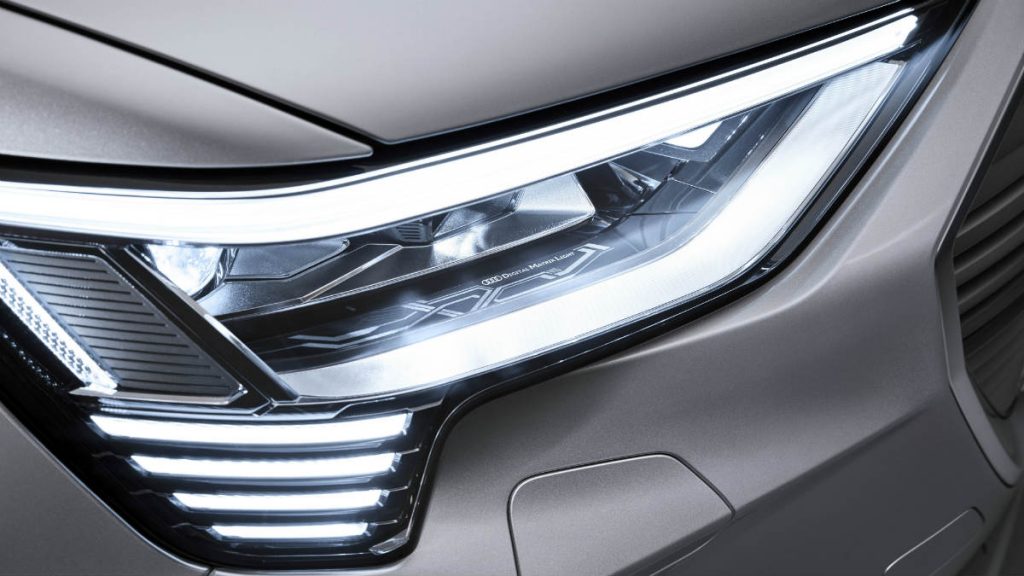
The front end stays true to Audi’s current e-tron visual language: the octagonal Singleframe grille filled with vertical struts painted a light platinum grey—a colour cue that flags these models as electric without shouting about it. The headlights are optional matrix LED units with 1 million micromirrors per side, breaking ground as the first mass-produced pixel-light system. They don’t just light the road; they shape it. Lane markers get their own illuminated strip. Road users get masked out so they never blind into your headlights. On narrow country roads at night, the orientation beam paints dark lanes on either side of your actual path to help you stay centred. It’s clever, but also exactly the sort of detail that separates Audi’s approach from Tesla’s minimalist playbook.
Step along the flanks and you’ll spot the blacked-in wheel arch trims, the matte anthracite sills, and the sculptural character lines that run from nose to tail. The sportier S Line trim swaps those black bits for body-colour accents—including the bumpers, mirror caps, and diffuser. Audi also offers a black Styling Package for anyone who wants to push further into monochrome territory, hiding the window surrounds and giving the Singleframe a darker treatment.
Out back, the slope kicks in hard after the B-pillar. The D-pillars rake sharply, and the tailgate itself is a single-piece unit that opens electrically—or via foot movement if you’ve optioned that kit. Inside the boot, you get 615 litres with the rear seats up. Fold them down and that jumps to 1,655 litres. Yes, that’s about 50 litres less than the regular e-tron because of the sloping roof—but most families will barely notice unless they’re regularly loading pallets of furniture through the hatch.
Under the Skin: Two Motors, One Message
Power comes from two asynchronous electric motors—one on each axle—fed through power electronics. The flagship 55 Quattro variant produces 265 kW (355 hp) continuously, with a boost function that punches it to 300 kW (402 hp) for eight seconds at a time. Torque figures sit at 561 Nm normally and climb to 664 Nm when the boost button is deployed. That takes the 2,295 kg kerb weight from standstill to 100 km/h in 6.6 seconds on routine drive, or 5.7 seconds on boost. Top speed is electronically limited to 200 km/h—plenty for any Autobahn afternoon, not that an electric SUV would make a great Autobahn guest anyway given the range anxiety factor.
For buyers who don’t need the extra muscle, Audi is also offering the 50 Quattro at launch. It runs a smaller 71 kWh gross battery (64.7 usable) with a reduced motor output of 230 kW and 540 Nm. It’s the entry point, and it targets a different buyer entirely: someone who wants the Audi badge and theSportback’s looks without committing to the pricier 55 spec.
All torque transfers through single-speed planetary gearboxes, selected via a small thumb-operated switch built into a low centre-console lever that doubles as an armrest. Front-wheel drive only? Rarely. The rear motor handles most everyday cruising for efficiency. The front kicks in predictively—to avoid slip before it happens, to correct understeer mid-corner, or simply because you asked for more thrust.
The battery architecture itself deserves a mention. In the 55 Quattro, the 95 kWh gross pack (86.5 kWh net) sits flat beneath the cabin, bolted at 35 points to a rigid aluminium protective frame. Thirty-six pouch-cell modules arranged across two floors keep weight low and centre of gravity even. Axle load distribution sits at roughly 50:50. Weight distribution that rivals anything Porsche has tried with the Taycan, minus the Taycan’s price tag.
Regenerative braking can pull up to 220 kW—more than 70% of total system output—and accounts for nearly 30% of overall range in typical driving. The transition between regen and hydraulic braking happens seamlessly. You won’t feel the moment the disc pads bite because the electrohydraulic control system coordinates everything behind the scenes. Three stages of coasting recuperation are adjustable via steering wheel paddles, and the system is even more granular than what’s offered in the non-Sportback e-tron.
Charging Reality Check
DC fast charging maxes out at 150 kW for the 55 Quattro (120 kW for the 50). Twenty minutes gets you to 80% state of charge—that’s about 350 km of additional WLTP range. Not lightning-fast, but acceptable given that 150 kW hasn’t become universal across the EV industry yet. The 50 Quattro reaches the same 80% mark in the same timeframe despite the slower peak rate because the smaller battery fills quicker relative to its capacity.
AC charging through a standard Mode 3 cable supports up to 11 kW. An optional second onboard charger bumps that to 22 kW, available from summer 2020. Audi’s own etron Charging Service currently covers roughly 120,000 public points across 21 European countries. Plug & Charge authorisation will roll out alongside the summer update, meaning the car authenticates at the station without a card or app tap.
Home charging works through the standard compact charging unit plugged into a 230 V outlet (up to 7.4 kW) or a 400 V three-phase socket (up to 11 kW). Audi’s optional connect charging stem adds smart scheduling—off-peak rates, solar integration—if you’ve got photovoltaic panels and a compatible home energy management system.
Inside: Technology Without Overwhelm
Climb inside and the first thing you notice isn’t the screens—it’s the sense of space. The headroom penalty versus the regular e-tron is just 20 mm, almost imperceptible. Rear legroom matches the SUV version thanks to the same 2,928 mm wheelbase. The floor tunnel is essentially flat; there’s no massive hump ruining foot placement for a middle-seat passenger.
The cockpit centres on twin touchscreens embedded in a glossy black panel that arcs from door to door. The upper display measures 12.1 inches; the lower one, 8.6 inches. Both operate with tactile feedback—audible clicks confirm every selection. Navigation, phone, media, and dedicated e-tron controls live on the screen above. Climate settings, text input, and convenience functions occupy the screen below. No physical buttons cluttering the dash unless you count the drive-select rotary dial hidden beneath the gloss panel.

Behind the steering wheel sits the Virtual Cockpit Plus, a 12.3-inch high-resolution display offering two layout modes. The ‘power meter’ central gauge replaces the conventional rev counter, showing real-time energy flow and regeneration status. Head-up projection is optional but worth considering if you spend long stretches on unfamiliar highways.
Voice control uses natural-language parsing rather than rigid command lists. You say “I’m cold” and it raises the temperature. You say “navigate home” and it pulls from your contacts. Interrupt it mid-sentence and the dialog manager yields gracefully—the sort of implementation that actually feels useful rather than gimmicky.
Seat options span standard fronts, sport seats, S sport seats, and contour seats with heating, ventilation, and massage. The optional contour lighting package wraps ambient illumination around door panels and centre console, paired with a welcome jingle played through the audio system at startup. Upgrade to the Bang & Olufsen Premium 3D sound system and city driving becomes almost meditative—the insulation work on the e-tron platform silences road noise better than anything else at this price point.
Driver Assist: The Tour Package Worth Considering
Base equipment includes Audi pre sense basic, pre sense front, and the pre sense 360° collision detection suite. These cover frontal impacts, cross-traffic alerts, and seatbelt tensioning protocols. Add the Assist Package City and you pick up intersection assist, lane change warnings, and exit warnings for junctions ahead.
The real drawcard is the Assist Package Tour. Adaptive cruise assist handles both longitudinal speed control and lateral lane keeping simultaneously—not merely lane deviation correction, but genuine active steering assist on suitable roads. Efficiency Assistant uses navigation data, onboard sensors, and Car-to-X information to suggest (and sometimes execute) early lift-off points on downhill gradients and upcoming junctions. With traffic sign recognition feeding speed limits into the cruise system, the car practically drives itself on familiar routes.
Park assist, night vision assist with pedestrian highlighting, and 360-degree camera views round out the available driver aids. Data flows from up to five radar units, five cameras, and twelve ultrasonic sensors through a central controller that builds a constantly updated occupancy map around the vehicle.
Edition One: What You Actually Get
At market launch, Audi is limiting the “Edition One” specification to plasma blue paint—the exclusive new colour developed specifically for the Sportback’s debut. It rides on 21-inch exclusive wheels, wears orange brake calipers, and features virtual exterior mirrors with OLED interior displays replacing traditional glass. Panoramic glass roof, illuminated door sill trims projecting “edition one” onto the pavement, Valcona leather upholstery in Monaco grey, Bang & Olufsen 3D sound, and the full Assist Package Tour complete the package. This is effectively the top-of-the-range configuration bundled together for early adopters who want maximum spec without building their own configuration order from scratch.
The Bottom Line
The Audi e-tron Sportback represents the brand’s attempt to prove that an electric vehicle can carry emotional appeal alongside utility. Coupe styling rarely suits practicality, but Audi has done enough here to keep cargo space viable while still delivering a profile that looks purposeful rather than compromised. The driving dynamics remain firmly anchored in Audi’s longstanding strengths—balanced chassis, predictable handling, refined ride quality—even when the propulsion method departs entirely from convention.
Vehicle data
| Make | Audi |
| Model | e-tron Sportback |
| Generation / chassis code | Not stated in sources |
| Model year(s) covered | 2020 |
| Body style | Electric SUV coupé |
| Powertrain / engine | Dual asynchronous electric motors (front + rear) |
| Power / torque | 55 Quattro: 265 kW continuous / 300 kW boost; 561 Nm / 664 Nm boost 50 Quattro: 230 kW / 540 Nm |
| Transmission | Single-speed gearbox (two-stage planetary with thumb selector) |
| Drivetrain | Quattro electric all-wheel drive |
| Key performance figures | 55 Quattro: 0–100 km/h in 6.6 s (5.7 s boost); top speed 200 km/h 50 Quattro: 0–100 km/h in 6.8 s; top speed 190 km/h |
| Price | Not stated in sources |
| On-sale / announcement period | Announced November 2019; market launch at time of article |
| Market | Europe (Germany) |
| Battery capacity | 55 Quattro: 95 kWh gross / 86.5 kWh net 50 Quattro: 71 kWh gross / 64.7 kWh net |
| Range (WLTP) | 55 Quattro: up to 446 km 50 Quattro: up to 347 km |
| DC fast charging | 55 Quattro: up to 150 kW 50 Quattro: up to 120 kW |
| Drag coefficient | 0.25 (with S Line exterior and virtual mirrors) |